
Trace and access plumbers in Cornwall & Devon
We trace the leak, open up the smallest possible area to reach it, and hand you the insurer-ready report. One visit, fixed price, no call-out fee.
Call now: 07822 025 911DCI Leak Detection provides trace and access across Cornwall and Devon: we pinpoint your hidden leak with thermal imaging, acoustic equipment and tracer gas, open up one small precise spot to reach it, and document the whole job in an insurer-ready trace and access report. Fixed pricing, no call-out fees and No Find, No Fee on residential work (subject to terms).

A trace and access plumber does two jobs in one visit. First the trace: locating exactly where water is escaping, without exploratory holes. Then the access: opening up the smallest possible area to reach the pipe. If you want the background on the term itself, including what trace and access cover usually pays for, our plain-English guide to what trace and access is covers it all.
This page is for the practical bit: booking the work. After more than 30 years finding leaks across Cornwall and Devon, we run trace and access as a single, documented service. You get the leak found, the access made cleanly, and a report written for your insurance claim, all at a fixed price agreed before we set off. No call-out fees, and No Find, No Fee on residential jobs (subject to terms).
What you get: the find, and the proof
Escape of water is one of the most expensive problems in UK homes. The Association of British Insurers has reported that these claims cost insurers around £1.8 million every day, which is exactly why insurers want a leak professionally located and documented before money changes hands.
A DCI trace and access visit gives you both halves of that:
- The find. The leak’s position marked precisely, confirmed by more than one detection method, so any repair opens up one small spot rather than half a room.
- The documented report. A written record of what we found, where, how we found it and what it will take to put right, with the photographic evidence attached. It is the paperwork your claim stands on.
Why insurers take our reports seriously
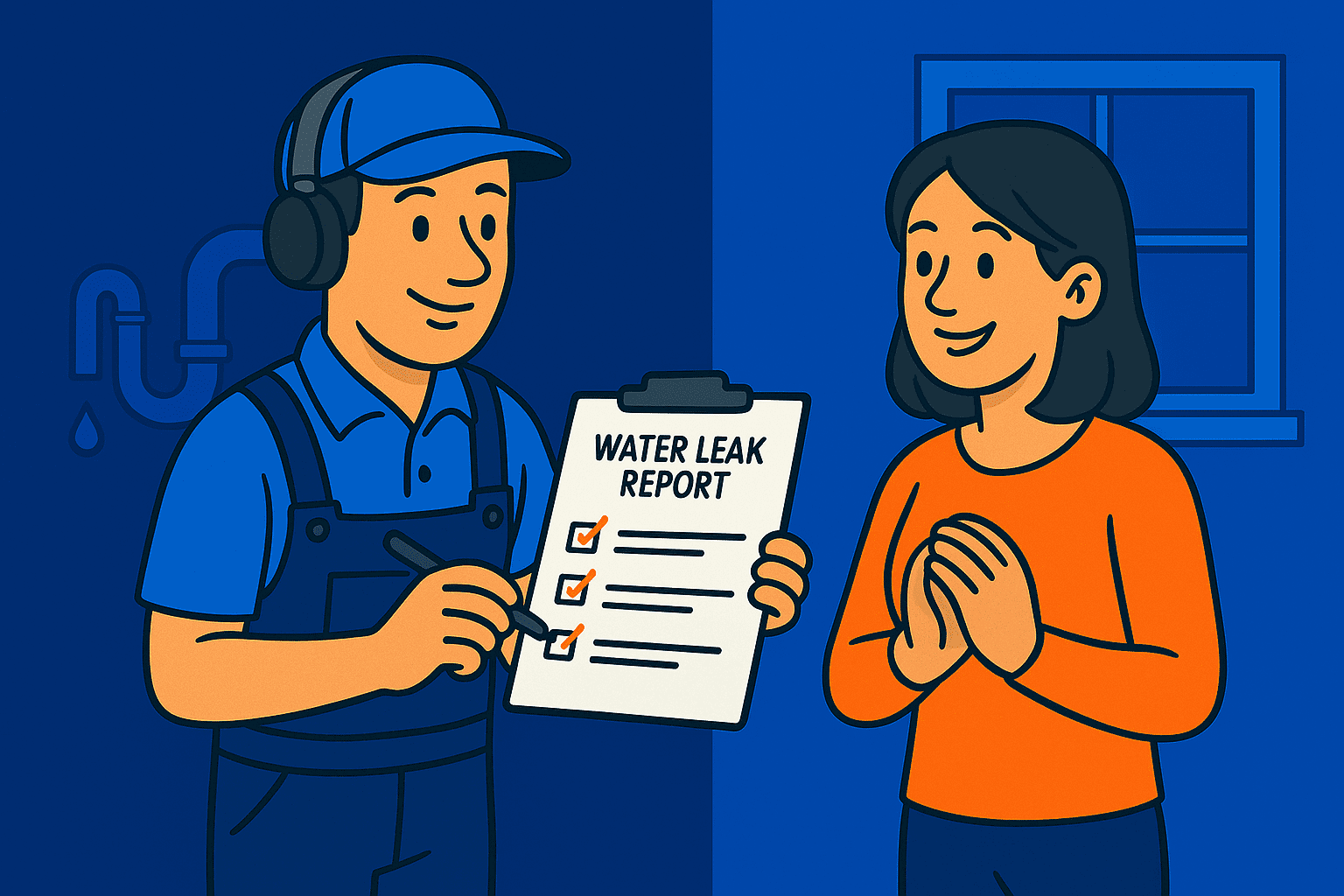
A claims handler or loss adjuster cannot see your property. They can only see the evidence in front of them, so our reports are built to give them everything they need to validate the claim without a second visit:
- The exact leak location, with photographs of the marked position
- The detection methods used and what each one showed, including thermal images and moisture readings where relevant
- The cause and condition of the failed pipework, where visible
- A description of the access made and the making good required
- Dates, the property details and our findings in plain English
Most UK buildings policies include trace and access cover, which usually pays for professionally locating the leak and making good the access damage, though limits vary and the underlying pipe repair is not always included. Check your own wording, and if the numbers matter to you before you book, our trace and access cost guide breaks down what affects the price.
You can choose your own specialist
When you report a leak, your insurer may offer to send a contractor from its own network. Many homeowners assume they have to accept. Usually you do not.
Financial Ombudsman Service guidance on buildings claims confirms that policyholders can generally ask to use their own contractor instead of the insurer’s nominated firm. The insurer will normally want to agree the scope and cost before work starts, and some policies limit what they pay to what their own network would have charged, so check your wording and keep your insurer informed. But the choice of who walks through your door is, in most cases, yours.
That matters here in the South West. A local specialist who knows Cornish granite floors, cob walls and long rural supply runs will usually get to the leak faster, and with less mess, than a generalist sent down from up country. If you would rather have DCI do the trace and access, tell your insurer that is your preference and we will work to their requirements.
The process, start to finish
Every trace and access job follows the same structure, whether it is a pinhole in a heating loop or a failed joint under a kitchen floor:
Talk it through
You describe the symptoms over the phone: the damp patch, the bill, what your insurer has said. We give you a fixed price for the visit before we set off. No call-out fee.
Survey and pressure test
On site, we map the pipework and isolate sections of the system. Pressure testing confirms there is a live leak and narrows down which circuit it sits on.
Pinpoint the leak
We combine acoustic leak detection, FLIR thermal imaging and, for stubborn leaks, tracer gas leak detection using the industry standard 5 per cent hydrogen in nitrogen mix, which is non flammable and safe in use.
Precise access
With the position confirmed, we open up the smallest area needed to expose the pipe. Often that means lifting a single tile or cutting one neat opening, not stripping a room.
Document everything
Photographs before, during and after, thermal images, moisture readings and the marked leak position all go on file while we are still on site.
Report delivered
You receive the full trace and access report, written for your insurer’s claims process, plus our advice on the repair and the making good.
Trace and access specialist vs a general plumber
A good plumber is exactly who you want once the leak is exposed. The problem is the finding. Without detection equipment, the honest options are educated guesses and exploratory holes, and every wrong guess is more damage to make good:
| What matters | General plumber | DCI trace and access |
|---|---|---|
| Finding the leak | Visual checks and exploratory openings | Pinpointed with acoustic, thermal and tracer gas equipment before anything is opened |
| Damage to your home | Grows with every wrong guess | One small, precise access point |
| Insurance paperwork | An invoice, sometimes a brief note | A full trace and access report with photographs, thermal images and findings |
| Pricing | Often hourly, open ended while searching | Fixed price agreed up front, no call-out fee |
| If nothing is found | You still pay for the time | No Find, No Fee on residential work (subject to terms) |
The two are not rivals. On straightforward jobs we can often repair the leak on the same visit, and on bigger repairs the report tells your own plumber exactly where to work and what they will find when they get there.
What happens after we find it
Finding the leak is the turning point, not the finish line. Here is how the rest usually runs:
- The repair. Simple fixes, such as a failed joint, can often be sorted there and then. Larger repairs get a clear written recommendation, and because the leak is exposed and documented, any competent plumber can price the work accurately.
- The reinstatement. Making good the access damage, such as re-laying the lifted tile or patching the opening, is the part trace and access cover is designed for. The report records exactly what was disturbed and why.
- The claim. Send your insurer the report with your claim. If you are new to the process, our guide to making a water leak insurance claim walks through it step by step.
If the leak sits on your incoming main or somewhere under the garden, the same visit can fold in mains water leak detection or underground leak detection, and for everything inside the house our core water leak detection service covers the lot.
Covering the whole of Cornwall and Devon
We are based near Saltash, right on the Cornwall and Devon border, which puts the whole of both counties within reach for fast emergency response. From Penzance to Plymouth, Bodmin to Barnstaple, the team that answers the phone is the team that turns up: a local Cornwall business, not a franchise.
That local knowledge shows in the work. Older granite and cob properties, solid floors with buried heating runs, long private supply pipes crossing fields: these are the jobs we handle every week, and they are exactly the situations where precise trace and access saves the most disruption.
Need a trace and access plumber you can book today?
One visit finds the leak, makes the access cleanly and gives you the report your insurer needs.
Call Dickie on 07822 025 911
No Find, No Fee on residential work (subject to terms). No call-out fees, fixed prices agreed up front, and a local team covering the whole of Cornwall and Devon. You can also email hello@dcileakdetection.co.uk or use the quote form above.
07822 025 911Find us in Cornwall & Devon
Trace and access services across Cornwall & Devon
Recent trace and access jobs
Real jobs from our records, with the customer details left out:
Where we cover
We provide trace and access across Cornwall and Devon from our base at Tideford, near Saltash. Local pages: Plymouth, Exeter, Truro, St Austell, Newquay, Falmouth, Torquay, Newton Abbot, Barnstaple, Liskeard, Saltash, Tiverton, Bodmin, Launceston, Penzance, Helston, and the full list on our Cornwall and Devon pages.