
Thermal imaging leak detection in Cornwall & Devon
Our thermal cameras show the temperature patterns a hidden leak leaves behind, so we can pinpoint it without lifting a single tile or floorboard.
Call now: 07822 025 911Thermal imaging leak detection uses an infrared camera to spot the surface temperature patterns a hidden leak creates, such as a warm stripe over a leaking heating pipe or a cool patch where damp is evaporating. DCI Leak Detection uses FLIR thermal cameras across Cornwall and Devon, verifies every finding before anything is opened up, and offers No Find, No Fee on residential work (subject to terms).
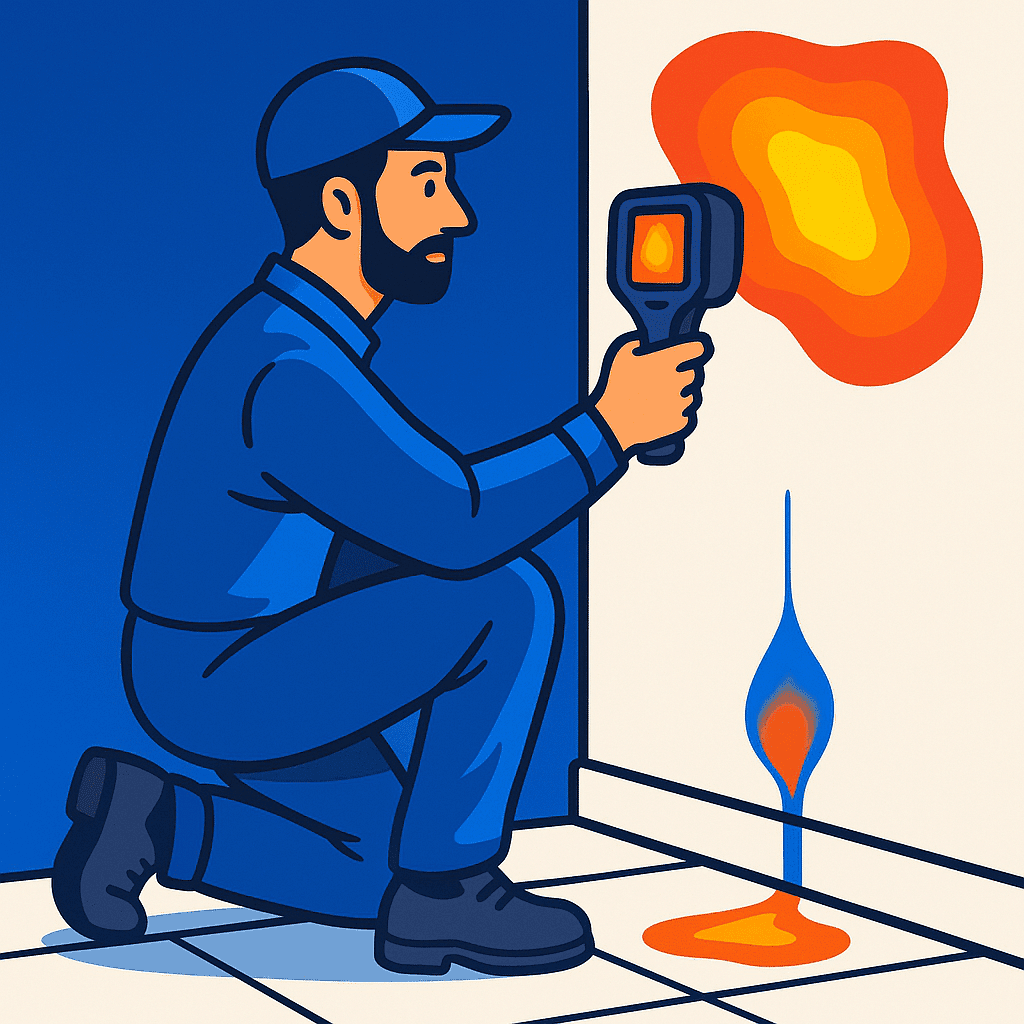
A hidden leak always leaves a clue, even when you cannot see a drop of water. Water moving where it should not changes the temperature of the surface above it, and a thermal imaging camera makes that change visible on screen. A leaking heating pipe under a tiled floor shows as a warm trail. A damp patch behind plasterboard, cooled by evaporation, shows as a cold one.
After more than 30 years finding leaks across Cornwall and Devon, thermal imaging is often the first tool out of our van. It lets us scan whole floors, walls and ceilings in minutes, completely non invasively, and tells us exactly where to point the rest of our equipment. No call-out fees, fixed pricing agreed up front, and No Find, No Fee on residential leak detection (subject to terms).
How thermal imaging finds hidden leaks
Every surface gives off infrared radiation, and the amount it gives off depends on its temperature. A thermal camera reads that radiation and turns it into a colour map of the surface, where warmer areas appear bright and cooler areas appear dark. The camera operator’s job is to read those patterns and work out which ones are normal and which ones are a leak.
Leaks create two tell-tale signatures. A leak on a hot water or heating pipe warms the floor or wall directly above it, so the pipe run and the leak point glow on the camera. A cold water leak or an established damp patch works the other way: as the moisture evaporates it cools the surface it sits on, so guidance from camera manufacturers such as FLIR and UK thermography trainers like iRed describes active damp showing up as a cooler pattern against its dry surroundings.
Because the camera sees the pattern and not just a single point, it also reveals the water’s path. Water rarely shows up where it escapes; it tracks along pipes, joists and screed before surfacing somewhere else entirely. The thermal image shows that journey, which is how we trace a ceiling stain in one room back to a pipe two rooms away.
What a thermal camera can and cannot see
We would rather you understood the honest limits of the method than believed a sales pitch. A thermal camera does not see water, and it does not see through walls. It sees the temperature of the surface in front of it, nothing more. FLIR’s own building inspection guidance and iRed’s thermography training both make the same point: thermal imaging finds suspect areas, and those areas must then be confirmed with other evidence, such as moisture meter readings, before anyone cuts a hole.
| Thermal imaging CAN | Thermal imaging CANNOT |
|---|---|
| Show the warm trail of a leaking heating or hot water pipe under floors and behind walls | See water itself, or look through solid walls and floors like an x-ray |
| Reveal cool evaporation patterns where damp is active on a surface | Find a leak with no temperature difference from its surroundings |
| Map the path water has taken across a ceiling or down a wall | Confirm a leak on its own, with no verification from moisture readings or other methods |
| Scan large areas quickly without touching the building | Work reliably on rain-soaked external fabric or surfaces just heated by direct sun |
Conditions matter too. The survey needs a measurable temperature difference between the leak and everything around it, which is why we sometimes run the heating before scanning, and why a wall freshly warmed by sunshine can hide what we are looking for. An experienced operator knows when the conditions are wrong and says so, rather than handing you a pretty picture that proves nothing.
Where thermal imaging shines

Some jobs are made for a thermal camera. These are the ones where it earns its keep:
Underfloor heating loops. The pipework is buried in screed, so there is nothing to see and nowhere to listen. The camera shows the whole heating circuit glowing through the floor, and a leak appears as a blossom of heat spreading away from the loop. If your system keeps losing pressure, our guide on what happens when underfloor heating leaks explains what to do first, and our underfloor heating leak detection service takes it from there.
Ceiling leaks. A stain on the ceiling tells you water arrived, not where it came from. Scanning the ceiling from below maps the wet area precisely and follows it back towards the source, often a bathroom or heating pipe well away from the stain. Our article on finding a leak in walls or ceilings covers the checks you can make yourself before calling us.
Wet insulation. Insulation that has taken on water holds and releases heat differently from dry insulation, so soaked sections show their own thermal pattern. That makes the camera a fast way to map how far water has spread through an insulated floor, flat roof or wall build-up, which matters for drying plans and insurance claims.
Central heating circuits. A pressurised heating system that keeps dropping is one of the most common jobs we see, and warm water makes the strongest possible thermal signature. The camera traces the buried pipe runs and flags the leak point for our central heating leak detection survey to confirm.
Heated swimming pools. Warm water escaping from a pool’s buried pipework leaves a similar plume for the camera to find without lifting a slab. Pool work has its own pages: swimming pool leak detection to pinpoint the fault, with swimming pool repairs handled by the same team.
When we combine thermal with acoustic and tracer gas
Thermal imaging is one tool in the kit, not the whole kit. Cold water mains leaks, leaks under thick concrete and leaks outdoors often produce little or no usable temperature pattern, and on those jobs the camera takes a supporting role.
That is when we bring in acoustic leak detection, using ground microphones and correlators to hear pressurised water escaping, and tracer gas leak detection, where the pipe is charged with the industry standard mix of 5 per cent hydrogen in 95 per cent nitrogen. The mix is non flammable and safe in use, and the gas escapes through the leak and rises to the surface, where a sensitive detector picks it up directly above the fault.
Used together, the methods cross-check each other: the camera narrows the search, the acoustics or gas confirm the exact point, and moisture readings prove it. That is what professional water leak detection looks like, and it is why we never recommend opening anything up on the strength of a thermal image alone.
What a thermal imaging survey looks like
Talk it through
You describe the symptoms over the phone: the pressure drop, the damp patch, the stain. We agree a fixed price for the survey before we set off. No call-out fee.
Set the conditions
On site we get the temperature difference working for us, for example by running the heating so warm pipe runs stand out clearly on camera.
Scan methodically
We scan the suspect floors, walls and ceilings in a grid pattern with our FLIR camera, recording every thermal anomaly rather than stopping at the first one.
Verify the findings
Each suspect area is checked with moisture readings, and with acoustic or tracer gas methods where needed, before we call it a leak.
Mark, photograph, report
We mark the confirmed leak position, save the thermal images and write up the evidence. Most domestic surveys take between one and three hours.
Why finding it early matters
A hidden leak does its damage quietly. Guidance from the US Environmental Protection Agency notes that mould can begin growing on wet materials within 24 to 48 hours, and the longer water runs into screed, timber or insulation, the longer the drying takes and the bigger the repair bill. Because a thermal survey is quick and completely non invasive, there is no reason to wait until the damage forces your hand. One scan either finds the problem or rules it out, and either answer is worth having.
Ready to see what your walls are hiding?
One thermal imaging survey can pinpoint the leak without a single hole, with the evidence your insurer needs.
Call Dickie on 07822 025 911
No Find, No Fee on residential leak detection (subject to terms). No call-out fees, fixed prices, and a local team covering the whole of Cornwall and Devon. You can also email hello@dcileakdetection.co.uk or use the quote form above.
07822 025 911Find us in Cornwall & Devon
Thermal imaging leak detection across Cornwall & Devon
Recent thermal imaging leak detection jobs
Real jobs from our records, with the customer details left out:
Where we cover
We provide thermal imaging leak detection across Cornwall and Devon from our base at Tideford, near Saltash. Local pages: Plymouth, Exeter, Truro, St Austell, Newquay, Falmouth, Torquay, Newton Abbot, Barnstaple, Liskeard, Saltash, Tiverton, Bodmin, Launceston, Penzance, Helston, and the full list on our Cornwall and Devon pages.