
Reviewed by the DCI Leak Detection team · Last updated September 2026
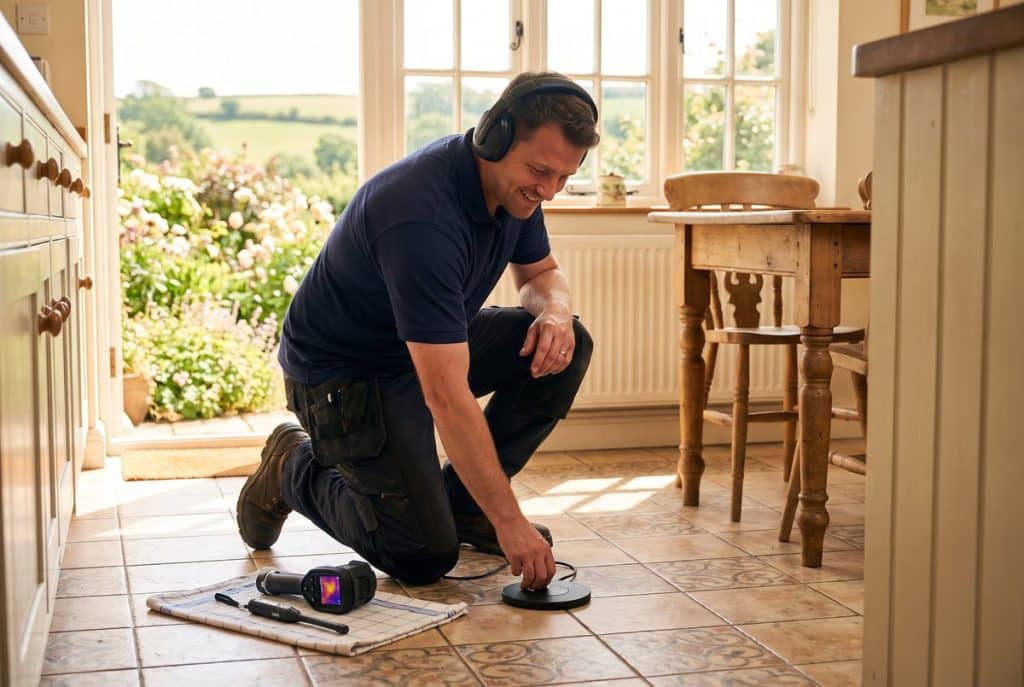
Professional leak detection equipment is a package, not one gadget: acoustic correlators and ground microphones, tracer gas (5% hydrogen in nitrogen) with a detector, thermal imaging cameras, moisture meters, pressure test rigs, pipe locators and endoscope cameras. A homeowner can use a moisture meter, a water meter test and a smart leak sensor. The rest takes training to read.
No single instrument finds a hidden leak. Each tool answers one question, and the skill is choosing the order and reading the results. Below: what each tool finds, what it cannot do, and whether buying or hiring makes sense.
On this page
- Acoustic equipment
- Tracer gas
- Thermal imaging cameras
- Moisture meters
- Pressure test rigs
- Pipe and cable locators
- Endoscope cameras and dye
- Water leak detectors you can buy
- Smart sensors and the meter test
- The kit compared
- Which equipment for which leak?
- Buy or hire?
- How DCI uses the kit
- Frequently asked questions
Acoustic leak detection equipment: correlators, ground microphones and listening sticks
Three instruments listen for the noise water makes as it forces its way out of a pressurised pipe.
A leak noise correlator uses two sensors fixed to fittings either side of the suspected leak. The noise reaches the nearer sensor first. From that time difference, plus the pipe material, diameter and sensor spacing, it calculates where along the run the leak sits. Our guide to what a leak correlator is has the detail.
A ground microphone then pinpoints: the operator moves it along the route and the leak is where the reading peaks. A listening stick is the simpler version.
The limits are all about sound. A small leak at low pressure may be inaudible, plastic pipe (including modern MDPE supply pipe) carries leak noise poorly, and traffic can swamp both. DCI uses them on buried supply pipes within underground water leak detection; the full method is on our acoustic leak detection page.
Tracer gas leak detection equipment
The kit is a gas cylinder with a regulator, plugs to seal the pipework, and a hand held detector. For the chemistry, the limits and what to do before a test, read tracer gas leak detection explained. The gas is 5% hydrogen in 95% nitrogen: non-flammable, non-toxic and, the manufacturers state, safe in drinking water pipework.
The suspect section is drained, sealed and filled with gas at its normal working pressure. Hydrogen is the lightest gas there is, so it escapes through the leak, rises through screed, concrete, tarmac or soil, and is picked up at the surface.
It finds what acoustic kit cannot: quiet leaks, plastic pipe, and pipes in a solid floor. The pipe must be emptied first, and the gas follows the path of least resistance, so it can surface a short distance from the leak. For DCI this is the main under slab leak detection equipment, standard for underfloor heating; see tracer gas leak detection and slab leak detection.
Thermal imaging cameras
A thermal camera reads surface temperature. It does not see water and it does not see through walls, as FLIR itself says. What it shows is a pattern: a leaking heating pipe warms the floor above it, and water evaporating from a damp wall cools the surface.
It scans a room in minutes and the images go in the report. But it needs a temperature difference, so a cold pipe in a cold floor can be invisible, and draughts, missing insulation and sunlight all mimic leaks. FLIR's advice is to confirm with a moisture meter. DCI uses FLIR cameras as the first sweep on heating leaks and ceiling stains (see thermal imaging leak detection); the deeper read is can thermal imaging see through walls?
Moisture meters
A pin meter measures electrical resistance between two pins pushed into the material; wet material conducts better. A pinless meter reads a short way below the surface without leaving marks. Professionals scan with pinless and confirm with pins.
It confirms a patch flagged by the camera is wet and maps where the damp stops. Readings on plaster are relative, metal and old salts push them up, and a meter never says where the water comes from. It is the professional tool a homeowner can use well: see how to read a moisture meter and thermal imaging vs moisture meter.
Pressure test rigs
A hand pump or gas cylinder, a gauge and a set of caps. Close off one section of pipework at a time, pressurise it and watch. A steady reading means that section holds; a continuing fall means it is losing water. Temperature moves a gauge too, so readings are taken over time.
It locates nothing, but it proves which circuit leaks, so the detection kit goes to the right place. DCI uses it first on heating, pools and mains; pressure testing pipes explained covers the detail.
Pipe and cable locators
Before anyone listens or digs, they need the route. A CAT (cable avoidance tool) picks up the signals buried services give off, and a Genny puts a traceable signal onto a metal pipe so the CAT can follow it and estimate its depth. Plastic pipe carries no signal, so it needs a sonde, ground penetrating radar or the acoustic kit.
A locator is underground water leak detection equipment only in the sense that it maps the run; the leak is found by the correlator, microphone or gas. See how to locate water pipes underground.
Endoscope cameras and dye testing
An endoscope, or borescope, is a camera a few millimetres across on a flexible lit cable. Fed through a gap or a small drilled hole into the void behind a bath panel or under a floor, it shows the joint on a screen. It confirms a suspected joint before anything is opened up.
Dye is the low-tech tool. Food colouring in a cistern shows a passing flush valve if colour reaches the pan without a flush. In a pool, dye released beside a crack or fitting with the pump off is drawn into the gap if water is escaping. Dye confirms a spot you already suspect.
Water leak detectors you can buy: what a sensor can and cannot do
Search for "water leak detector" and the results are gadgets, not services: battery sensors from around the price of a takeaway, smart versions that message your phone, and whole-house units that close a motorised valve on the incoming main when they see flow at 3am. They are worth having, and they solve a different problem from the kit above.
A spot sensor detects water that has already reached the floor where it sits: under a washing machine, behind a toilet, in the airing cupboard, next to the boiler. It raises the alarm early, which is the point, and it can turn a ruined kitchen into a mopped floor. What it cannot do is find a leak. It does not know that a heating pipe under the screed is weeping, that a supply pipe is losing water under the drive, or that the drip it has just caught started two rooms away. Whole-house flow monitors are better at spotting a hidden leak because they watch consumption, but they still only tell you that water is going somewhere, not where.
So the honest answer to "which water leak detector should I buy?" is: a spot sensor for each wet appliance and a flow monitor if you have a holiday let or leave the house empty in winter, and a specialist with the equipment on this page when either of them goes off and you cannot see the water. Our separate guide on whether smart leak detectors are worth it compares the types in more detail.
Smart leak sensors and the water meter test: the homeowner's leak detection kit
A point sensor alerts your phone when water touches it. A flow monitor on the incoming main flags flow when nothing should be running, and the better ones close a valve automatically. Neither finds a leak already running under a floor, as are smart leak detectors worth it? explains.
The water meter test costs nothing. South West Water's method: turn off every tap and appliance, read the meter before bed and again in the morning. If it has moved, water is leaking. Close the internal stop tap and repeat: still moving means the supply pipe, stopped means indoors. Our free one-minute leak checker walks you through it.
Leak detection equipment compared
| Tool | Best for | Cannot do | DIY or professional |
|---|---|---|---|
| Leak noise correlator | Narrowing a buried leak to a section | Work without pipe data; hear plastic well | Professional |
| Ground microphone | Pinpointing once the section is known | Hear a silent leak; beat traffic noise | Professional |
| Tracer gas and detector | Quiet leaks, plastic pipe, solid floors | Work on a full pipe; give an instant result | Professional |
| Thermal imaging camera | Fast sweep for heating leaks and damp | See through walls; show cold water in a cold floor | Either, with confirmation |
| Moisture meter | Confirming and mapping damp | Say where the water comes from | DIY |
| Pressure test rig | Proving which circuit leaks | Locate the leak within it | Professional on heating |
| Pipe and cable locator | Tracing metal pipe route and depth | Find the leak; trace plastic without a sonde | Professional |
| Endoscope camera | Viewing a suspected joint in a void | Search a large area | Either |
| Smart sensor or flow monitor | Early warning and automatic shut-off | Locate a running leak | DIY |
Which equipment for which leak?
Underground supply pipe
Meter test, then a locator to trace the route, a correlator to narrow the section and a ground microphone to pinpoint. On plastic pipe or a quiet leak, tracer gas instead.
Central heating under a floor
Pressure test to prove the circuit, thermal imaging to trace the warm run, tracer gas to pinpoint the joint, moisture meter to confirm before the floor is opened.
Under a concrete slab
Tracer gas does most of the work, because it rises through the slab where acoustic kit often cannot hear; a ground microphone confirms a loud leak on metal pipe.
Swimming pool
Each pipe run is pressure tested separately. Listening equipment and dye check the skimmer, returns, light niche and shell; tracer gas finds breaks in buried pipework. See swimming pool leak detection.
Inside a wall or ceiling
Thermal imaging and a moisture meter find the wet area, an endoscope through a small hole confirms the joint, and a pressure test proves a heating pipe before anything is cut.
Should you buy or hire leak detection equipment?
Buy the cheap end: a digital moisture meter and a couple of smart sensors cost little and stay useful. A correlator, ground microphone set or tracer gas rig costs a great deal and is used once, so few outside the trade own one.
That leaves water leak detection equipment hire. Sewerin's UK arm hires correlators, ground microphones and pipe locators, and national tool hire firms list ground microphone kits, correlators and thermal cameras by the week, with a minimum period and a delivery charge.
The fee buys the instrument, headphones and a manual, not the rest of the job. A correlator needs the pipe material, diameter and exact sensor spacing, and returns a confident position from bad inputs. A ground microphone takes practice before a leak sounds different from a boiler pump or a road. Tracer gas needs plugs, gas and a drained, sealed system. That is why a hired correlator without training rarely finds the leak.
How DCI uses the kit in Cornwall and Devon
Every job starts with the cheapest evidence: a meter reading, the boiler gauge and a walk round, which usually say which system is losing water. Pressure testing isolates the circuit. Granite and cob walls, solid floors and long rural supply pipes are common across Cornwall and Devon, so tracer gas and acoustic methods do more of the work here. Thermal imaging and the moisture meter confirm the find, and everything goes in the trace and access report.
Frequently asked questions
What equipment is used to detect water leaks?
Professionals carry a set of tools rather than one device: a pressure test rig to prove which pipe run leaks, acoustic correlators and ground microphones for buried pipes, tracer gas with a detector for quiet leaks and solid floors, a thermal imaging camera, a moisture meter, pipe locators and an endoscope camera.
Can I hire leak detection equipment and find the leak myself?
You can hire ground microphones, correlators and thermal cameras by the week. Whether you find the leak is another matter. A correlator needs the pipe material, diameter and exact sensor spacing to give a true position, and a ground microphone takes practice to tell a leak from a pump or traffic.
What is the best equipment to detect water leaks underground?
For a buried supply pipe the usual sequence is a pipe locator to trace the route, a correlator to narrow the leak to a section, and a ground microphone to pinpoint it. Plastic pipe carries sound poorly, so a quiet leak on plastic is often found with tracer gas instead.
Can a thermal imaging camera find a leak under a concrete floor?
Only if the leak changes the floor temperature. A leaking heating pipe warms the slab above it and shows as a warm line. A cold water leak under concrete often shows nothing, because the camera reads surface temperature and cannot see through the slab. Tracer gas or acoustic kit finds those.
Is tracer gas safe to use in a home?
Yes. The tracer gas used for water leak detection is 5% hydrogen in 95% nitrogen. At that concentration it is non-flammable and non-toxic, and manufacturers state it is safe in drinking water pipework. The pipe is drained and sealed first, then filled with gas at its normal working pressure.
Is a water leak detector worth buying?
Yes, as an early warning. A spot sensor under each wet appliance and behind the toilet catches water on the floor before it spreads, and a flow monitor on the main will notice a hidden leak by the water it uses. Neither can locate the leak, so treat an alarm as the moment to call a specialist, not the diagnosis.
Do I need a professional, or will a moisture meter do?
A moisture meter confirms that a patch of wall or floor is damp and shows where the damp stops. It will not tell you where the water comes from. If the reading is highest near pipework, or the damp keeps returning, the source needs tracing with pressure testing, thermal imaging, acoustic or gas methods.
Sources: Gutermann, Sewerin, FLIR, Protimeter, Radiodetection, South West Water and Leak Tools. Checked September 2026.
Rather have the kit and the experience turn up together?
DCI Leak Detection finds your leak across Cornwall and Devon with acoustic, tracer gas and thermal imaging equipment, and gives you an insurer-ready report. No find, no fee on residential work, subject to terms. We cover the whole of Cornwall and Devon.
Call Dickie on 07822 025 911 Fast response across Cornwall & Devon · Insurance-approved reports