

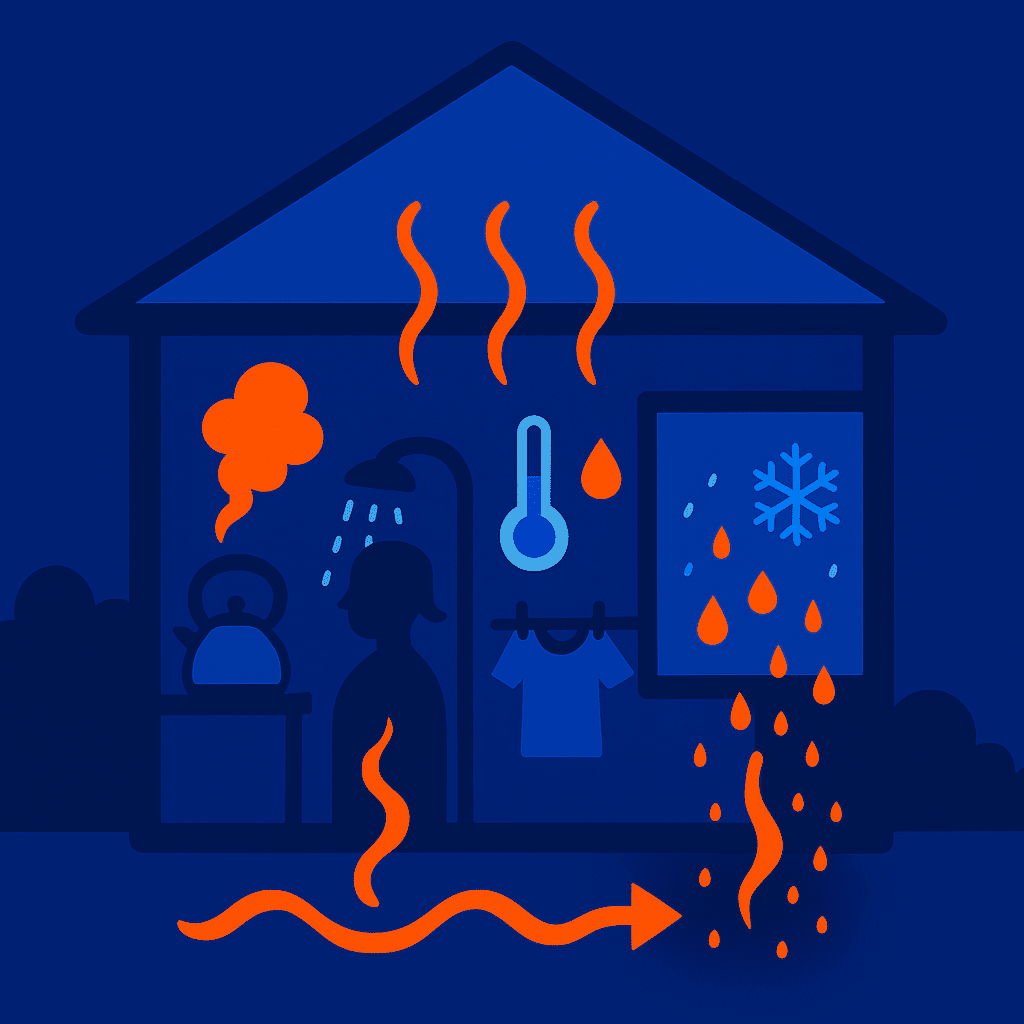
Condensation forms when warm, moisture-laden indoor air meets a cold surface and cools below its dew point, turning the water vapour back into liquid. Everyday activities (cooking, showering, drying washing indoors, even breathing) add moisture, while cold windows and walls give it somewhere to settle. Fix it with ventilation, steady heat and moisture control. If a damp patch keeps spreading, suspect a hidden leak.
Wake up to streaming windows, a musty corner or black speckles creeping across the ceiling and it's natural to fear the worst. The good news is that most household damp is condensation, a moisture-and-temperature problem you can usually fix yourself. The catch is that condensation and a slow hidden leak can look almost identical, and treating one when you've actually got the other wastes time while the damage grows. Here's what causes condensation, how to stop it for good, and the warning signs that tell you it's really a leak.

On this page
What causes condensation?
Air holds water vapour, and warm air holds more of it than cold air. When that warm, humid air touches a surface that's colder than its dew point (the temperature at which the air can't hold any more moisture), the vapour cools and turns straight back into liquid water. That's the film you see on a cold window or bathroom mirror, and it's the same physics behind dew on the grass at dawn.
In a home, three things have to line up for condensation: moisture in the air, cold surfaces, and too little ventilation to carry the damp air away. As the UK guidance on damp and mould puts it, air can only hold so much water vapour, and when it meets a cold surface that moisture becomes droplets. That's why condensation favours north-facing external walls, window reveals, cold corners, and the backs of wardrobes and cupboards where air barely moves.
The everyday moisture you don't notice
Most condensation is simply normal life adding water to the air faster than your home can clear it. The biggest culprits are the obvious ones, but the volumes surprise people.
- Drying clothes indoors is the worst offender: a single load on an airer can release up to nine pints (around five litres) of water into the air, according to council damp-and-mould guidance.
- Cooking and boiling. Pans without lids pump steam into the kitchen.
- Showering and bathing. That fogged mirror is condensation in real time.
- Breathing and everyday occupancy. A household quietly adds litres of moisture a day just by being home.
- Unflued bottled-gas and paraffin heaters, which the Energy Saving Trust warns produce a great deal of moisture (and fumes). They are one of the quickest ways to make condensation worse.
None of this is a fault with your house. It only becomes a problem when the moist air has nowhere to go and meets cold surfaces. Then it shows up as misted glass, damp patches and, eventually, mould.
The humidity sweet spot
Relative humidity is the single most useful number for understanding condensation. A cheap hygrometer (often built into a digital thermometer) tells you where you stand. The widely cited comfortable range for UK homes is:
| Relative humidity | What it means |
|---|---|
| 40% to 60% | ✔ The general comfort zone, with low condensation and mould risk |
| 35% to 50% (winter) | ✔ Aim lower in cold weather, when walls and windows run colder |
| Above 60% for long spells | ✘ Too much moisture. Act on ventilation and moisture sources |
| 65%+ | ✘ Black mould growth becomes far more likely |
These bands are echoed across UK damp and indoor-air specialists. The winter figure matters most: in cold weather your windows, external walls and corners can be several degrees colder than the room, so even moderate humidity can hit the dew point on those surfaces and run with condensation. The aim isn't bone-dry air, because below about 30% gets uncomfortable. It's keeping moisture in that middle band.
Practical fixes that actually work
Tackling condensation comes down to three jobs: make less moisture, get rid of what you do make, and keep surfaces warmer. You rarely need all of these, so start with ventilation, the cheapest and most effective.
1. Ventilate every day, briefly
The Energy Saving Trust's core advice is to keep trickle vents open and clear and to open windows for short bursts rather than leaving the house to stew. Council guidance suggests "flush ventilation", opening windows in opposite rooms for 20 to 30 minutes, to change the air without losing all your heat. Always use the extractor fan when you cook, shower or bathe, and leave it running afterwards until the mirror clears.
2. Cut the moisture at source
- Dry washing outside whenever you can; if you must dry indoors, do it in one room with the door shut and a window cracked, or use a vented tumble dryer.
- Put lids on pans when cooking and keep the kitchen door closed.
- Wipe down windows and shower screens with a cloth or squeegee.
- Consider a dehumidifier for a persistently damp room. The Energy Saving Trust notes it can help pull excess moisture from the air.
3. Keep it gently warm
Cold surfaces are half the equation, so steady background warmth helps. The advice is to keep rooms you're using at a sensible temperature. The Energy Saving Trust suggests above 18°C, and NHS guidance recommends not letting any room get too cold (at least around 15°C). A little heat in every room beats blasting one room hot and leaving the rest cold, which just drives moisture into the chilly spaces. Heat alone won't fix condensation, though. Warm, damp air still needs ventilating out.
When it's not condensation, it's a hidden leak
Here's where it pays to look closely. Condensation and a slow leak both leave damp and mould, but they behave differently, and a leak won't respond to any amount of ventilation. This article focuses on the practical tells. For a full side-by-side breakdown, see our guide on how to tell condensation from a leak.
| Likely condensation | Likely a hidden leak |
|---|---|
| A film of droplets or surface misting on cold glass and walls | A defined damp patch, often with a brown or yellow tidemark ring |
| Worst on cold, north-facing walls, corners and windows | Can appear anywhere, including warm internal walls and ceilings |
| Clears with heating and ventilation | Stays wet and keeps spreading regardless of ventilation |
| Tracks the weather and daily activity (worse on cold mornings) | May worsen after rain, or with heavy water use, or be constant |
| No effect on your water bill | Often paired with an unexplained rise in the water bill |
A reliable check: run a moisture meter over the area and compare it with a known-dry wall nearby. Surface condensation reads high only at the face; a leak usually shows raised moisture deeper into the material. The single biggest red flag is a patch that stays wet and grows after you've ventilated and warmed the room properly. That's a leak until proven otherwise.
This matters beyond the decorating. Persistent damp feeds black mould, rots timber and frames, and carries real health risks. The NHS links damp and mould to worsened asthma and chest infections, with babies, older people and anyone with a respiratory condition most at risk. If in doubt, it's worth ruling a leak in or out early.
When to call a specialist
If a damp patch keeps spreading despite good ventilation and heat, shows a tidemark, or arrives alongside a high water bill with no visible leak, it's time to stop guessing. Professional water leak detection uses non-invasive equipment, including thermal imaging, acoustic sensors and tracer gas, to pinpoint the source without opening up floors and walls on a hunch. You find out for certain whether you're dealing with condensation or a leak, and exactly where to act.
Frequently asked questions
What causes condensation in a house?
Condensation forms when warm, moist indoor air touches a cold surface and cools below its dew point, so the water vapour turns back into liquid. Everyday activities like cooking, showering, drying clothes indoors and even breathing add moisture, and cold windows, walls and corners give it somewhere to settle.
What is the ideal indoor humidity to avoid condensation?
Most UK homes are comfortable and safe from condensation at roughly 40 to 60 per cent relative humidity, dropping to around 35 to 50 per cent in winter. Sustained readings above 60 per cent mean too much moisture, and 65 per cent or higher makes mould growth far more likely.
Does heating the house stop condensation?
Steady, gentle background heat helps a lot, because warmer surfaces are less likely to cool moist air to its dew point. Aim to keep rooms you use above about 18°C. Heating alone isn't enough, though. You still need ventilation to remove the moisture, not just warm it up.
How do I know if it's condensation or a leak?
Condensation usually appears as a film of droplets on cold surfaces like windows and external walls, and clears with heat and ventilation. A leak tends to leave a defined damp patch with a brown or yellow tidemark ring that grows, stays wet, or worsens after rain or heavy water use. A persistent, spreading patch is the clearest sign to investigate.
Can condensation cause damage like a leak?
Yes. Left unchecked, condensation feeds black mould, rots timber and window frames, and damages plaster and decoration. The health risks matter too. The NHS links damp and mould to asthma flare-ups and chest infections, especially in babies, older people and anyone with a respiratory condition.
When should I call a leak detection specialist about damp?
Call a specialist when a damp patch stays wet despite good ventilation and heating, keeps spreading, shows a tidemark, or comes with an unexplained rise in your water bill. These point to a hidden leak rather than condensation, and non-invasive detection finds the source before you start opening up floors or walls.
Damp that won't dry out? Let's find out if it's a leak
If a patch keeps spreading whatever you do, we'll trace it across Cornwall & Devon with non-invasive equipment. No guesswork, minimal damage, and a clear answer fast.
Call Dickie on 07822 025 911 No Find, No Fee on residential leak detection (subject to terms)