
Reviewed by the DCI Leak Detection team · Last updated September 2026
A pool that loses more water with the pump running usually has a leak on the pressure side: the return lines or the plant after the pump. More loss with the pump off points to the suction lines or the shell. The same loss either way is the shell, fittings or light. Evaporation is about 6 mm a day.
Search for "swimming pool losing water pump" and most of what comes back is about liners and skimmers. Our guide to where swimming pools leak covers those. This article is about the other half: the pump, filter and valves in the plant room, and the pipework buried between plant room and pool.
On this page
How much water a pool should lose
An uncovered pool loses water to evaporation every day, more when it is warm and windy: the industry figure is about a quarter of an inch, roughly 6 mm, a day. SPATA, the UK pool trade association, gives 3 mm in 24 hours as a guide for an uncovered indoor pool and says outdoor pools lose significantly more. Add splash, the water carried out on swimmers (about 0.75 litres per swimmer per exit, says SPATA) and backwashing, and the four together can take 25 to 30 mm off an outdoor pool in a week. Heating the water raises evaporation too.
So a few millimetres a day in August is normal. Needing the hose every other day is not. The bucket test tells the two apart in 24 hours, so do that first.
The pump on, pump off test: plant side or shell side?
Once the bucket says leak, this free test says which half of the pool to look at.
Fill the pool to its usual level, switch off any automatic top-up, and mark the level with tape on the tile line. Run the pump as normal for 24 hours and measure the drop. Refill to the mark, leave the pump off for 24 hours, and measure again, starting at the same time of day.
A pool's pipework has two halves. The suction side runs from the skimmers and main drain to the pump; the pressure side runs from the pump through the filter and heater and back to the pool through the return lines. With the pump running the pressure side is pushing water out, so a split there loses more. A crack on the suction side is under vacuum while the pump runs and pulls air in instead; when the pump stops, the weight of the pool pushes water out through it.
Swimming pool losing water when pump is on
Pressure side: the return lines and jets, plus everything in the plant room after the pump.
Pool losing water when pump off
Suction side, or the shell. Bubbles in the pump basket while it runs mean a suction line is drawing air.
Losing the same either way
The shell, its fittings or the light niche. The pump makes no difference to those.
The test says which side, not where.
The plant room walk-through
Go in with a torch, with the pump running and again with it off. A pool filtration system leak usually leaves a mark even when the water has gone.
The pump: seals and unions
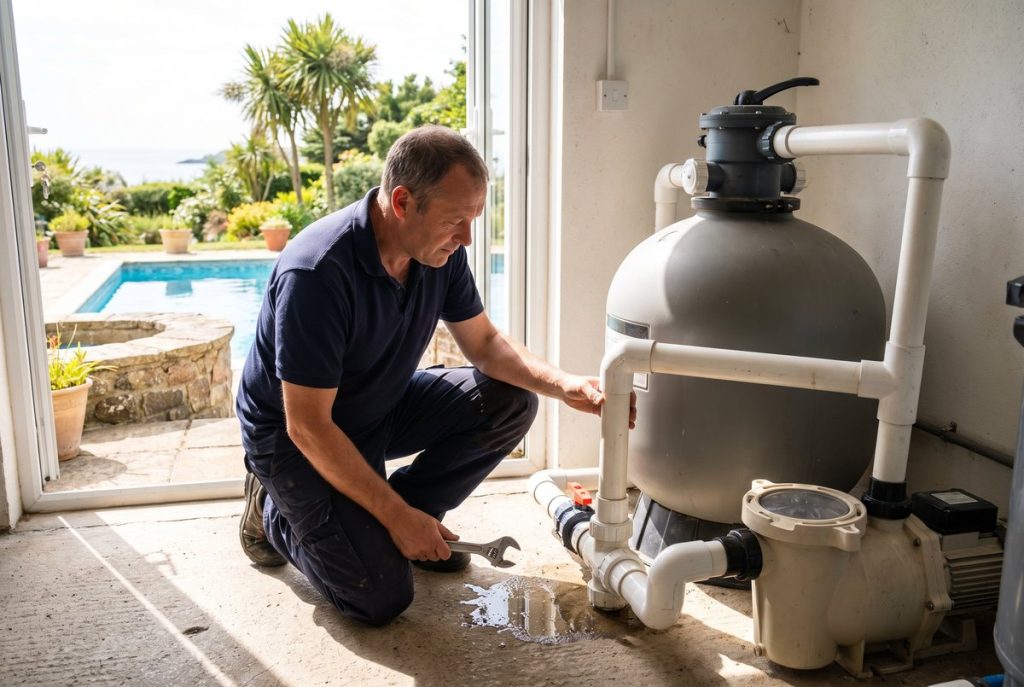
A puddle under the pump where the motor meets the wet end is the mechanical shaft seal: replace it before the bearings run in water. A drip or spray at a union or the discharge fitting only shows with the pump on. A pool pump leaking air rather than water is a different fault: a lid o-ring, drain plug or suction union letting air in, shown by bubbles in the basket and lost prime. Certikin's pump manual says the same: tighten the suction side unions, or replace the mechanical seal.
The multiport valve and the waste line
The multiport valve on top of the filter is the commonest hidden loss in a plant room, because the water leaves down the waste line and never touches the floor. When the rubber spider gasket inside wears or tears, water crosses to the waste port with the handle on Filter, and the pool loses water for every hour the pump runs. To check for a multiport valve leaking to waste, dry the end of the waste pipe, run the pump and watch. A drip or trickle that carries on once the system has settled is the gasket or a weak diverter spring. Its other seals leak onto the floor, in plain view.
The filter tank and its laterals
The tank leaks at the drain plug, at the clamp band holding the valve on, and occasionally through a crack in the body. Gaskets are cheap; a cracked tank usually means a new filter. Sand in the pool is a cracked lateral or standpipe inside the tank. That is not a water leak, worth knowing before you pay someone to hunt for one.
Heater and heat pump connections
A heat pump makes water on purpose: humid air condenses on the cold coil and drips into a tray, so a puddle under one is often nothing. Test it with a chlorine strip: condensation has none, pool water does. If the strip reacts, check the unions and o-rings on the water connections, then the heat exchanger, which corrodes when the water runs acidic. Gas and oil heaters leak at the same places, and all of it with the pump on.
Chlorinator and dosing lines
Feeders and dosing pumps leak at the lid o-ring, the inlet and outlet connections and the small bore tubing to the injection point. Liquid chlorine makes fittings hard to keep sealed, so this kit weeps more than the rest, and a weep into a floor gully is easy to miss. Look for white crust and bleached concrete.
Backwash and waste lines that discharge unseen
SPATA calls backwashing perhaps the most significant natural water loss from a pool, and the waste line ends at a drain or soakaway nobody watches. A valve passing to waste or a backwash set too often looks like a pool that will not hold its level. Find where the waste line comes out and watch it with the pump running.
Balance tanks on deck level pools
Deck level pools have no skimmers. Water spills over the edge into a channel, runs by gravity to a balance tank, and the pump draws from the tank; a float valve tops it up from the mains. The tank is usually underground beside the plant room, and it is where a pool plant room leak hides twice over: a crack loses water below ground and the top-up replaces it, so the pool level never drops. The tell is a top-up valve running more than it used to, and a tank level that falls with the pump off. Balance tanks are confined spaces, so look from the hatch only.
Plant room checklist
- Floor under the pump motor joint, the filter clamp band and the heater unions.
- Waste pipe outlet: dry the end, watch for five minutes.
- Pump basket: any bubbles?
- Puddle under the heat pump: chlorine strip.
- Automatic top-up: off for the tests.
- Deck level pool: balance tank level with the pump off.
What you notice, where to look, how to test
| What you notice | Likely area | Test |
|---|---|---|
| Level drops faster with the pump running | Pressure side: return lines, plant after the pump | Plant room walk-through, then pressure test each return line |
| Level drops faster with the pump off | Suction side: skimmer and main drain lines, or the shell | Dye at the fittings, pressure test the suction lines |
| Same drop either way | Shell, fittings, light niche | Dye test, note where the level stops falling |
| Trickle from the waste pipe on Filter | Multiport valve spider gasket or spring | Dry the pipe end, watch with the pump running |
| Puddle under the pump at the motor joint | Mechanical shaft seal | Look with the pump running; replace the seal |
| Bubbles in the basket, pump losing prime | Air leak on the suction side: lid o-ring, unions, drain plug | Pour water over the lid and joints, watch the bubbles |
| Water under the heat pump | Condensation, or a union or heat exchanger leak | Chlorine strip on the puddle |
| Sand in the pool | Cracked lateral or standpipe | Not a water leak: filter internals |
| Plant room dry, pool still dropping with the pump on | Underground return pipework | Pressure test each line, then tracer gas or listening |
Underground pipework between the plant room and the pool
If the plant room is dry and the test still says pressure side, the water is leaving through the return lines under the patio. A swimming pool pipework leak underground rarely shows on the surface, because the ground drains it away.
A pool has more buried lines than most owners realise: skimmer lines, the main drain, a return to each jet, often a vacuum point. They are tested one at a time. With the pump and heater off, every opening on one line is plugged and the line is filled with water and pressurised. A gauge that holds means the line is sound; one that falls means it leaks. Our guide to pressure testing pipes covers the method.
That proves which line, not where. To pinpoint, the line is emptied and filled with tracer gas, 5% hydrogen in nitrogen, which is non-flammable and rises through soil, concrete and paving to a detector at the surface. A camera pushed in from the plant room can show the break itself. Then either a small excavation over the spot, or pool pipe relining, which cures an epoxy coating or resin liner inside the existing pipe through its ends at the pool and plant room. Our swimming pool repairs page covers both.
Why a plant leak costs more than the water
Every litre that leaves through a return line or a passing valve has been filtered, heated and dosed, and what replaces it is cold mains water with no chlorine in it, so the heater and the dosing both work harder. On a holiday let or park pool that runs from Easter to October, a leak that started in May is still costing money in September. Our holiday let leak protection page is written for that.
What you can check yourself, and what needs a specialist
Safe to do: the bucket test, the pump on, pump off test, the checklist, nipping up a union by hand and swapping a lid o-ring or spider gasket.
Not sensible: opening a pressurised filter, pressure testing with unregulated air, climbing into a balance tank, and digging on a guess. If the plant room is dry and the water is still going, the leak is in the ground, and finding it is instrument work. A maintenance company that has swapped the obvious parts and is still topping up is at the same point.
DCI's swimming pool leak detection runs in that order: plant room, then each line isolated and tested, then gas or listening equipment to mark the spot. Our Ilfracombe pool case study shows the elimination on a real pool. No find, no fee applies to residential pools, subject to terms. Commercial and holiday park pools are quoted before we arrive.
Frequently asked questions
Why does my pool only lose water when the pump is running?
Because the leak is on the pressure side. The running pump pushes water at pressure through the filter, heater and return lines, so a split there loses water fast. With the pump off that pipework sits at pool level and barely leaks. Check the plant room, then have each return line pressure tested.
Why does my pool lose more water when the pump is off?
A crack on the suction side (the skimmer or main drain lines) is under vacuum while the pump runs and pulls air in rather than letting water out. When the pump stops, the weight of the pool pushes water out through it. The shell and its fittings leak regardless of the pump.
How much water should a pool lose in a week in the UK?
SPATA, the UK pool trade body, gives 3 mm in 24 hours as a guide for an uncovered indoor pool; outdoor pools lose significantly more. Evaporation, splash, water carried out on swimmers and backwashing together can take 25 to 30 mm a week off an outdoor pool. A steady loss well beyond that is a leak.
Does an underground pool pipe leak mean digging up the patio?
Not usually. Once the leaking line is proved and the break pinpointed with tracer gas or listening equipment, the repair is a small excavation over the spot or pool pipe relining, which cures an epoxy coating or resin liner inside the existing pipe through its ends at the pool and plant room.
Is swimming pool leak detection no find, no fee?
For residential pools, yes, subject to terms: if DCI cannot find your leak you do not pay the detection fee. Commercial pools, including holiday parks and hotels, are quoted before we arrive with the price fixed up front. Either way you get a written report with the leak position marked.
Sources: SPATA water losses factsheet, American Leak Detection, Latham Pools, Leak Tools and Anderson Manufacturing pressure testing and tracer gas guides, Atlantic Pool Leak Detection, Leak and Subsurface Locators, Inyo Pools, Litra Pool Care, Pool Research, Certikin Aquaspeed manual, Madimack, Pool Plant Courses, RS Pool, Sunset Pools, Pipepoxy. Checked September 2026.
Plant room dry and the pool still dropping?
DCI Leak Detection tests each pool line in isolation and pinpoints your leak with tracer gas and listening equipment across Cornwall and Devon, then repairs or relines the pipe without lifting the whole patio. No find, no fee on residential pools, subject to terms. Commercial pools quoted up front. We cover the whole of Cornwall and Devon.
Call Dickie on 07822 025 911 Fast response across Cornwall & Devon · Insurance-approved reports