
Reviewed by the DCI Leak Detection team · Last updated September 2026
A hot tub with the cover on and the pump off should lose almost nothing overnight. Retailers put normal evaporation at roughly 25 to 50 mm (one to two inches) a week, more with heavy use. Faster than that is a leak, and pump unions, pump seal and heater are where most start.
A hot tub losing water is one of the most common calls we get from holiday-let owners in Cornwall and Devon, usually as a guest message: "the tub is low again". Sometimes it is evaporation and four people climbing out dripping. Often it is a slow leak in the cabinet that has been topped up for months.
On this page
- Evaporation, splash-out or a leak?
- Where hot tubs leak, in order of likelihood
- Symptom, likely source and the check
- How to check safely
- Does leak sealer work on a hot tub?
- How a specialist finds the leak
- Holiday let hot tubs and the changeover problem
- Spring commissioning after a winter drain-down
- Frequently asked questions
Evaporation, splash-out or a leak?
Warm water in cool air evaporates. BISHTA's energy factsheet says the wider the gap between water and air temperature, and the more the jets churn the surface, the faster heat goes, and water goes with it. Bathers climbing out over the side move the level too. Retailers put normal loss, cover on, at 25 to 50 mm a week; a cover that no longer sits flat and daily use push it higher. What evaporation does not do is empty a tub overnight with the cover on.
So test it. Fill to the normal line, switch off at the isolator, put the cover on and mark the waterline with tape. Come back in 24 hours. A drop you can barely see is evaporation. A drop you can measure is a leak.
Then run the tub for 24 hours and compare. More loss running than resting points to the pressure side: pump, heater and the pipework out to the jets. The same loss either way points to the shell, a fitting below the waterline or a suction line. Let the level keep falling with the power off and it stops at the height of the leak. The bucket test in our guide on how to tell if your pool is leaking works the same way on a swim spa.
Where hot tubs leak, in order of likelihood
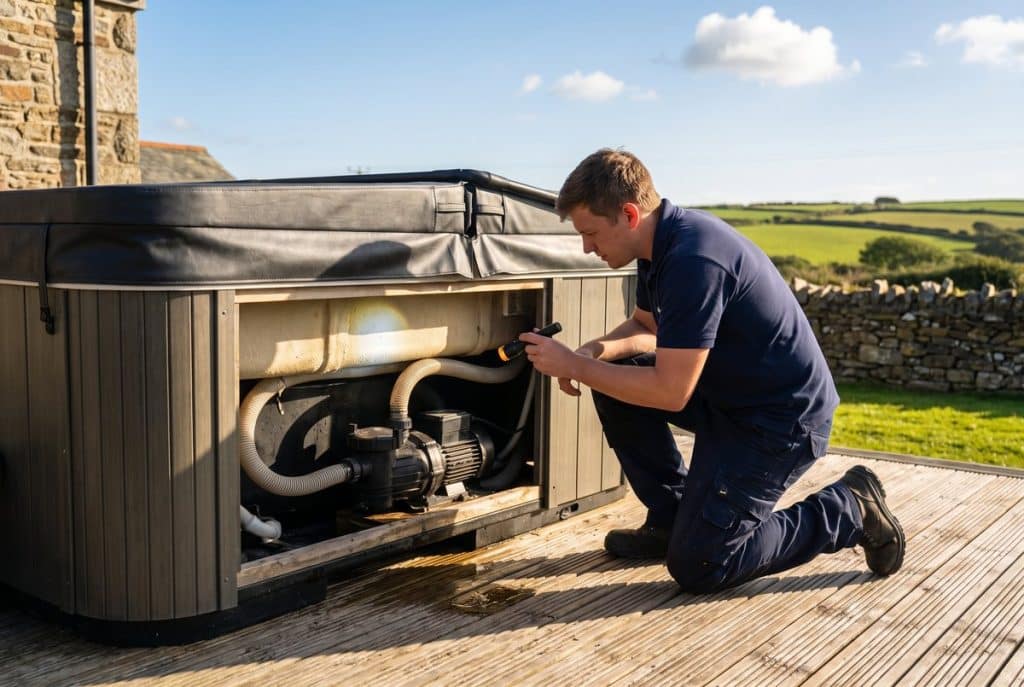
The wet end of the pump is the usual suspect. Two large plastic union nuts join the pipework to it, and they loosen with vibration and the warm-cool cycle; the O-rings inside wear too. Behind the unions is the shaft seal. A hot tub pump leaking there shows as water under the pump body, rust or scale on the motor, and often a noisier motor.
The heater comes next: unions at each end of the metal heater tube plus gasketed fittings for the sensor and flow switch. A hot tub heater leaking shows as rust streaks down the tube or a puddle beneath it, and the tube cracks if it has ever frozen.
Then the jets, each sealed to the shell with a gasket that hot, treated water slowly breaks down, with a glued joint behind. The manifolds and flexible PVC pipe feeding them sit in the foam behind the cabinet, where a joint can weep for months before anything shows outside.
Lower down the list: the shell around jets and lights (the light niche has its own seal; a true shell crack is the least common finding), the drain valve and its cap gasket, the filter housing, which cracks after a freeze, and the diverter valves. A hot tub leaking from underneath is nearly always one of these, running down through the foam and out at the base, rather than a hole in the shell.
Symptom, likely source and the check
| Symptom | Likely source | DIY check |
|---|---|---|
| Water under the pump, rust on the motor | Pump unions or shaft seal | Dry kitchen roll on each union, power off; then watch the pump run from outside the bay |
| Rust streaks on the heater tube | Heater unions or gaskets | Look only. Heater work is for an engineer |
| Level stops falling at jet height | Jet gasket or the glued joint behind it | Food colouring beside each jet on that line, pump off |
| Level falls to the footwell | Light niche, suction fitting or drain | Food colouring at the light and footwell fittings |
| Cabinet base damp, foam wet, bay dry | Flex pipe or manifold joint inside the foam | Specialist: trace it rather than dig out foam on a guess |
| Water appears only after a winter empty | Freeze cracks in the heater, filter housing, pump or manifold | Torch inspection before refilling, then a part fill and watch |
How to check safely
- Switch off at the wall isolator, the rotary switch outside. The topside panel is not enough.
- Take off the cabinet panel on the equipment side and look before you touch: puddles, white scale trails, rust streaks, foam that is dark or spongy.
- Press dry kitchen roll to each union, the heater fittings and the drain valve. A drip a minute that you cannot see will darken the paper.
- Stand clear, switch back on and run the pump for a few minutes, because some leaks only show under pressure. Switch off again before you go back in.
- Rest the tub with the cover on until the level settles, then dye test on that line: a few drops of food colouring in still water beside each jet, the light and the footwell fittings. Water leaving through a gap draws the colour in.
Does leak sealer work on a hot tub?
Hot tub leak sealer products such as Fix-A-Leak are sold for minor plumbing weeps and small shell leaks. The maker's own instructions tell you what you are dealing with: take the filter cartridges out first, so the particles that plug the gap do not collect in the filter, circulate for two days, drain after 48 hours, and expect most repairs to last one to two years.
Retailers are blunt about the limits. It cannot cure a pump shaft seal, does nothing for a loose union, and a cracked part needs replacing. The reasoning in our article on does leak sealer work for central heating applies here: it buys time on a small weep you cannot reach, and tells you nothing about where the leak is.
How a specialist finds the leak without ripping out the decking
On a free-standing tub, hot tub leak detection means the cabinet, the foam and patience. On an in-ground swim spa, or a tub sunk into decking with the plant boxed in elsewhere, the pipe runs are buried and guesswork gets expensive. The method is the one we use on pools.
Each pipe run is isolated and pressure tested on its own. A line that holds is cleared without a spade going in. A line that drops is drained, sealed and filled with tracer gas, 5% hydrogen in nitrogen, which escapes at the break and rises through decking or paving so the detector marks the spot from above; see tracer gas leak detection. On a heated spa, escaping warm water shows as a warm plume under the boards on a thermal camera, which reads surface temperature and needs the water warmer than its surroundings; see thermal imaging leak detection. Dye and listening equipment cover the shell and fittings.
The result is one marked spot and a written report, so a swim spa leak that would otherwise mean lifting the whole deck means lifting one section. DCI locates the leak and can repair pipework once found; the pump, heater or shell goes to the tub's manufacturer or a hot tub engineer, and the report tells them which part. Our swimming pool and spa leak detection service covers tubs and swim spas across Cornwall and Devon.
Holiday let hot tubs and the changeover problem
A holiday let hot tub leak goes unnoticed because nobody measures. The guest tops it up, the cleaner tops it up at changeover, and the tub is refilled every week anyway. The leak runs for a season.
Two things make that worse than the water bill. First, the equipment: a low waterline starves the pump, and the heater depends on flow across its element. Most controllers throw a flow or dry heater error and refuse to heat, which is the Friday-night message you do not want, and an element that runs dry can burn out. Second, hygiene. HSG282, the HSE guidance for hot tubs in business use, applies to a holiday let where one party has the tub for the stay. It expects chlorine at 3 to 5 mg/l or bromine at 4 to 6 mg/l, tested at least twice a day during a let, water changed each week or between groups, and the results recorded. Every top-up is untreated mains water going into dosed water, so a tub that needs filling daily is a tub whose morning reading no longer describes what guests are sitting in by evening.
Add these to the changeover routine:
- Note the waterline against a fixed mark on the shell before guests arrive and again at changeover, and log it with the water test.
- Open the equipment panel and check the bay floor, then the ground around the cabinet base and any decking edge.
- Ask departing guests whether they topped up, and put a line in the welcome pack asking them to tell you rather than do it.
- If the tub needs a top-up more than once between changeovers with the cover on, book a leak check before the next booking.
The tub is one item on the list. Our guide to protecting your holiday let from water leaks covers the house, and parks with tubs on several pitches have the extra problem of a shared supply, covered in leak detection for caravan and holiday parks. The free one-minute leak checker tells you whether the property's meter moves when everything, tub included, is off.
Spring commissioning after a winter drain-down
A tub left empty over winter cracks from the inside. Water that was not blown out of the pipes freezes in the heater body, the filter housing, the pump wet end and the manifolds, and the damage is thin cracks rather than clean breaks, so nothing shows until the tub is refilled and warm. Manufacturers exclude freeze damage from warranty.
Before the first fill, go over the heater, filter housing, pump and every visible joint with a torch, and check the unions by hand; they loosen while the tub sits empty and the O-rings dry out. Fill through the filter well so the pump does not airlock, part fill and watch the bay, then fill to the line and run the overnight mark test before the first guests. A hot tub losing water in March is a booking problem; in July it is a lost week.
Frequently asked questions
How much water should a hot tub lose in a week?
With the cover on, retailers put normal evaporation at roughly 25 to 50 mm (one to two inches) a week. Heavy use, a high set temperature or a worn cover push that up. If the level drops faster than that with the cover on and the tub switched off, suspect a leak.
Can I use leak sealer in a hot tub?
Products such as Fix-A-Leak are sold for minor plumbing and shell weeps. The maker's instructions say to remove the filter cartridges, circulate for two days and drain after 48 hours, and that most repairs last one to two years. Retailers say it cannot cure a pump seal, a loose union or a cracked part.
Does a leaking hot tub damage the pump or heater?
It can, once the level drops. A low waterline starves the pump, and the heater relies on flow across its element. Most controllers throw a flow or dry heater error and refuse to heat, and an element that runs without water can burn out. Top up, switch off, then find the leak.
Can you find a leak in an in-ground swim spa without lifting the decking?
Usually, yes. Each pipe run is isolated and pressure tested, so the lines that hold are cleared without digging. A failing buried line is filled with tracer gas, which rises through decking or paving above the break, and a thermal camera shows warm water escaping from a heated spa. The decking comes up in one place.
Does DCI repair hot tubs?
DCI finds the leak and gives you a report showing exactly where it is. Pipework and buried lines can be repaired once located. Pumps, heaters, shells and electrics are the job of the tub manufacturer or a hot tub engineer, and the report tells them which part has failed before they set off.
Sources: BISHTA, HSE HSG282, Marlig Fix-A-Leak, Caldera Spas, HotSpring, Jacuzzi, SpaDepot, Swim University, Canadian Spa Company UK, A6 Hot Tubs, Sewerin and FLIR. Checked September 2026.
Topping the tub up again?
DCI Leak Detection finds the leak in your hot tub or swim spa across Cornwall and Devon with pressure testing, tracer gas and thermal imaging, and gives you a report that tells the engineer what to replace. No find, no fee on residential work, subject to terms. We cover the whole of Cornwall and Devon.
Call Dickie on 07822 025 911 Fast response across Cornwall & Devon · Insurance-approved reports