
Tracer gas leak detection in Cornwall & Devon
The method that finds the leaks nothing else can. Safe gas, a sensitive probe and a precise mark on the floor, with no exploratory digging.
Call now: 07822 025 911Tracer gas leak detection fills the drained pipe with a safe mix of 5% hydrogen and 95% nitrogen. The hydrogen escapes at the leak, rises through soil, screed or concrete, and a sensitive surface probe picks it up directly above the fault. DCI Leak Detection uses it across Cornwall and Devon, with fixed pricing and No Find, No Fee on residential work (subject to terms).
Some leaks defeat every other method. A pinhole in a plastic pipe buried in screed makes almost no noise. A cold water leak under a concrete slab gives a thermal camera nothing to see. After more than 30 years finding leaks across Cornwall and Devon, we keep tracer gas on the van for exactly these jobs: the quiet ones, the deep ones and the ones hiding under floors nobody wants to dig up.
The principle is simple. Gas gets out of a pipe through the same hole the water does, and hydrogen is far better at escaping than water is. Charge the pipe with a safe tracer gas, wait for it to rise, and the leak gives its own position away. No call-out fees, a fixed price agreed before we set off, and No Find, No Fee on residential leak detection (subject to terms).
How tracer gas leak detection works
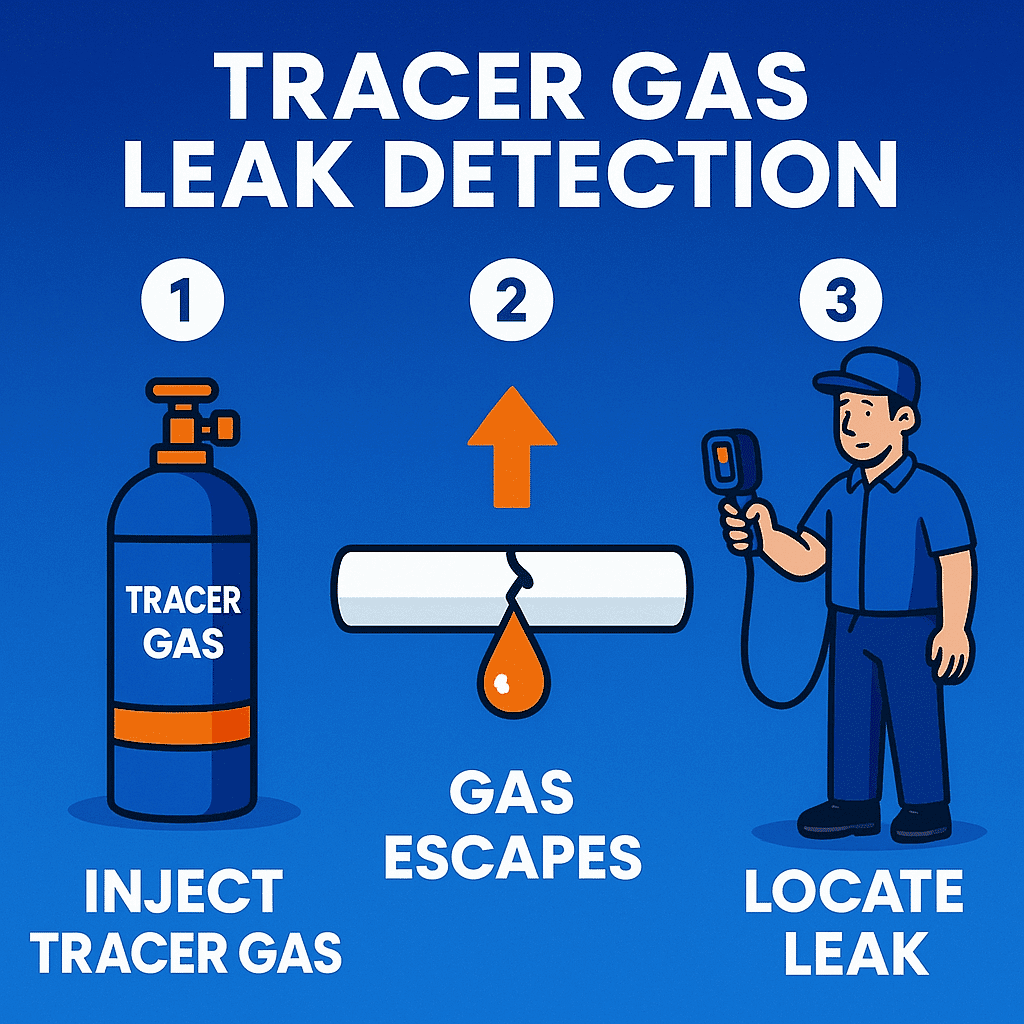
The tracer gas itself is the industry standard mix used by detection specialists across the UK: 5 per cent hydrogen carried in 95 per cent nitrogen. Hydrogen is the lightest gas there is, with the smallest molecules, so it slips through openings that barely show as damp. Here is the process from start to finish:
Isolate and drain
We isolate the suspect pipe run and drain the water out of it. The gas needs the pipe to itself, so the section under test comes out of service for the duration of the survey.
Charge with tracer gas
The hydrogen and nitrogen mix goes into the empty pipe through a regulator at a controlled pressure, filling the whole run from end to end.
The gas escapes at the leak
Wherever the pipe is holed, the gas gets out, just as the water did. Everywhere the pipe is sound, nothing escapes.
It rises to the surface
Being lighter than air, the hydrogen travels upwards through soil, screed, concrete and floor coverings until it reaches the surface above the leak.
We scan with the probe
A sensitive hydrogen detector is moved methodically across the floor or ground. The readings climb as the probe approaches the leak and peak directly above it.
Mark, photograph, report
We mark the position, photograph the evidence, then flush and refill the pipework. If you are claiming, the findings go into an insurance approved trace and access report.
Why tracer gas is safe

The word “hydrogen” makes some customers nervous, so it is worth being precise. The mix we use is classified as non flammable under ISO 10156, the international standard that determines whether a gas mixture can burn. At 5 per cent, the hydrogen is diluted in nitrogen, an inert gas that makes up most of the air you are breathing now, to the point where the mixture cannot ignite.
The mix is also non toxic and non corrosive. It leaves nothing behind in the pipework: once the survey is done, the system is flushed and refilled, and any gas that escaped simply disperses into the air. The same hydrogen and nitrogen trace mix is supplied by the major UK gas companies specifically for leak detection, and it is used in homes, schools and commercial buildings every day.
Where tracer gas excels
Tracer gas earns its place on jobs where the usual tools run out of road:
| Situation | Why other methods struggle | Why tracer gas works |
|---|---|---|
| Underfloor heating loops | Pipes snake through screed in tight loops, so noise and heat patterns are hard to read | Each loop is drained and charged in turn, and the gas surfaces over the fault |
| Plastic pipework | Plastic carries far less leak noise than metal, so acoustic listening has little to hear | The gas does not care what the pipe is made of |
| Under concrete and screed | Solid floors muffle sound and hide moisture until damage is widespread | Hydrogen rises through hairline gaps in the slab to the surface |
| Buried heating runs | A cooled or micro leak gives thermal imaging little to show | A drained and charged circuit reveals the fault regardless of temperature |
| Small, slow or intermittent leaks | Too quiet for microphones, too slight for obvious damp | Even a tiny opening lets hydrogen through |
If your problem is a wet patch on a solid floor, our guide on how to find a water leak under a concrete floor explains what you can check yourself before booking a survey.
Buried swimming pool pipework is another regular customer for tracer gas, because pool circuits sit under paving where nothing else gets a look in. The pool side of the job lives on our swimming pool leak detection page, and a confirmed pipe fault can usually be repaired without digging via pool pipe relining.
The honest limits of tracer gas
No method is magic, and we would rather you knew the trade-offs up front:
- The pipe has to be drained. The section under test is out of service while we work, and draining a large heating system takes time before the survey proper can start.
- Depth slows things down. The deeper the pipe and the denser or wetter the ground above it, the longer the gas takes to reach the surface. Some jobs need a waiting period between charging and scanning.
- Gas can wander. In some ground conditions the gas tracks along the pipe trench, a duct or a cavity before surfacing, which can put the strongest reading slightly away from the true leak. That is why we read the whole picture rather than trusting a single peak.
- Wind disperses it outdoors. Open, breezy sites need slower, more methodical scanning.
- It is not always the quickest tool. A noisy, pressurised leak on a metal main is often found faster with acoustic equipment. We use tracer gas where it is the right answer, not as a default.
When we combine it with thermal and acoustic
On most surveys, tracer gas is one instrument in an orchestra. A typical stubborn leak job runs like this: our FLIR cameras carry out thermal imaging leak detection to map the pipe runs and any temperature anomalies, acoustic leak detection narrows the search to a section, and tracer gas confirms the exact point before anyone reaches for a drill or a breaker.
Cross-checking methods matters because each one can mislead on its own. A warm patch might be a pipe running normally. A noise peak might be a fitting rattling. A gas reading might have travelled along a trench. When two or three independent methods agree on the same spot, that is a leak position you can open the floor on with confidence.
What a tracer gas visit looks like

It starts with a phone call. You describe the symptoms, we ask a few questions about your pipework and floors, and you get a fixed price for the survey before we set off. There is no call-out fee and no obligation.
On site, we confirm which circuit the leak sits on, isolate and drain it, charge it with the tracer gas and scan. Once the readings peak, we mark the position, photograph everything and talk you through what we found. You are left with one small, precise place to open up rather than a floor full of exploratory holes.
If you are claiming on your buildings insurance, the survey comes with a report written for the trace and access process: the method used, the readings, photographs and the marked leak position. Trace and access cover usually pays for locating the leak and making good the access damage, though limits vary by policy. Our plain English guide to what trace and access cover is explains how it works.
Ready to pin that leak down?
If a leak has beaten a plumber, a moisture meter or your own detective work, tracer gas is usually the method that ends the search.
Call Dickie on 07822 025 911
No Find, No Fee on residential leak detection (subject to terms). No call-out fees, fixed prices, and a local team covering the whole of Cornwall and Devon. You can also email hello@dcileakdetection.co.uk or use the quote form above.
07822 025 911Find us in Cornwall & Devon
Tracer gas leak detection across Cornwall & Devon
Recent tracer gas leak detection jobs
Real jobs from our records, with the customer details left out:
Where we cover
We provide tracer gas leak detection across Cornwall and Devon from our base at Tideford, near Saltash. Local pages: Plymouth, Exeter, Truro, St Austell, Newquay, Falmouth, Torquay, Newton Abbot, Barnstaple, Liskeard, Saltash, Tiverton, Bodmin, Launceston, Penzance, Helston, and the full list on our Cornwall and Devon pages.